Revised September 2025
Overview: This Quick Guide will help you get the intensity of your workouts dialed in for your heart rate monitor and power meter. Swimming pace is also described here.
My original heart rate-based zones were determined in 1987 and based on testing I did mostly with my clients at the time but also with random athletes. Things have changed significantly in the last thirty-some years. Measurements of lactate thresholds are now becoming common with the possibility of continuous lactate monitoring in the near future. All of this calls for a remodeling of the zones I use. That’s what follows.
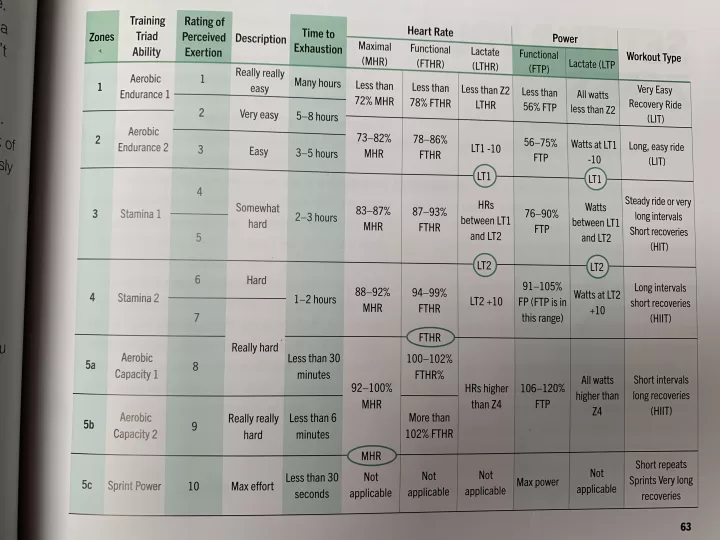
The most obvious change in what follows is that I no longer separate running and cycling heart rate zones by differing ranges. Now the “separation” depends on sport-related data such as lactate measurement during testing (LTHR), field testing to determine functional threshold heart rate (FTHR), or your known maximal heart rate (MHR). On the other had, power-based zones for cycling and pace zones for swimming remain unchanged. With all of this in mind, let’s start by examining heart rate zones for running and cycling. All of the heart rate zones for these two sports are shown in the accompanying Table (below) which is lifted from my recent book, The High-Performance Cyclist. Disregard the word “ride” in the last column in this table. It could as well be “run.”
The following is a brief overview of how to set your heart rate zones using the three methods listed above.
Setting Heart Rate Zones (Running and Cycling)
1. Using Max Heart Rate
Search your sport-specific training and racing data from the past year to find the highest heart rate of your season for running or cycling. Consider this your current maximum heart rate. On the accompanying zone Table below use the “Maximal (MHR)” column to determine your zones. All this takes is a calculator and you can quickly set up your zones. You’re done. This one is easy. Caution: Do not use 220 minus your age to find max heart rate as this is as likely to be wrong as right. And it could be way off. However, your known max heart rate from the past twelve months is likely to be much more accurate.
2. Using Functional Threshold Heart Rate
This is a bit more complicated than max heart rate involving field testing but may prove to be more accurate.
Step 1. Determine your functional threshold heart rate (FTHR) with a short test. This FTHR test is best done early in the Base and in the Build periods and then repeated every six weeks or so throughout the season. Changes are likely to be greater early in the season (such as in the Base period) and less likely later in the season (Build period).
To find your FTHR do a 20-minute time trial alone (no training partners and not in a race). Again, it should be done as if it was a steady race effort for the entire 20 minutes. When done look to see what your average heart rate was for the entire 20 minutes. Subtract 5%. That number is an approximation of your FTHR.
Note: I am frequently asked if you should go hard for the entire test. The answer is yes. Go hard for the entire time. But be aware that most people doing this test start too hard and then gradually fade for the remainder and crawl to the finish. That will give you inaccurate data. I tell my clients to start conservatively for the first 5 minutes and then decide if they can go a bit faster or not for the next 5. This decision is made every 5 minutes with each 5-minute segment being steady. The more times you do this test the more accurate your FTHR is likely to become as you will learn to pace better.
Step 2. Establish your training zones. Use the accompanying Table (below) to establish each zone.
3. Using the Lactate Measurement Method
Heart rate zones determined by using this method are potentially more accurate than either of the methods described above. I won’t offer a testing methodology here but would instead recommend you have the testing done by a lactate experienced coach or athlete as there is a long learning curve in mastering lactate testing.
By measuring the lactate in single-drop blood samples, usually taken from a finger prick, two thresholds can be established. The lower one, usually called “lactate threshold 1” (LT1), is at the junction of zones 2 and 3. LT1 (see Table) is 2 millimoles (2mm) and establishes the top end of your zone 2. Knowing the top of your zone 2 also tells you, by using the Table, the range of your zone 1. LT2 is at the border of zones 3 and 4. Once LT1 and LT2 are known, by using the Table you can set all of your zones,
Setting Power Zones (Cycling)
If you’ve already determined your heart rate zones by the above testing, this will be easy. To determine your Functional Threshold Power (FTPw) use the same 20-minute time trial test above for FTHR to determine your FTPw (both may be determined in the same test). Subtract 5% from your average power (not “normalized power”) for the 20 minutes of the test and you have FTPw. The same goes for your Lactate Threshold Power (LTP). This test may be done on the road or on an indoor trainer. The road will generally give better results so long as it is relatively flat or with a slight and steady upgrade, and free of stop signs and heavy traffic. (Keep your head up. Time trialing with your head down is very dangerous. I have a friend who is in a wheelchair now because of this.)
Once you know FTP or LTP use the “Power” column in the Table to determine your zones.
Table
Swimming Pace
Step 1. Determine your T-time. There are many ways of doing this. One of the most common is to swim a 1000-meter/yard time trial at your pool. It may help to have someone on deck counting laps as it’s easy to lose track in such a test. What you are trying to determine is your average 100 pace for the test. Simply swim 1000 and then divide your finish time by 10. This is your T-time. This should be done early in the Base period and every 6 weeks or so thereafter. The more times you do this test the more accurate your T-time will become as there is a learning curve in mastering pacing for a 1000. A table of swim zones may be found in any edition of my Triathlete’s Training Bible.
Step 2. In my training plans, and in my book’s workouts (in The Triathlete’s Training Bible) the swim workouts will often refer to pace as T-time plus (+) or minus (-) a few seconds. For example, T-time + 5 seconds would mean swimming at a pace that would be the equivalent of your T-time plus 5 seconds per 100. So if your T-time is 91 seconds this workout would be calling for you to swim at a 96 seconds per 100 pace. If it is a 50 meter/yard set you are doing, the time you are shooting for is 48 seconds (half of 96). In the same way, if the set calls for you to swim 150 meters/yards at T-time + 5 you would swim the distance in 2 minutes and 24 seconds (96 sec + 48 sec).

You must be logged in to post a comment.